
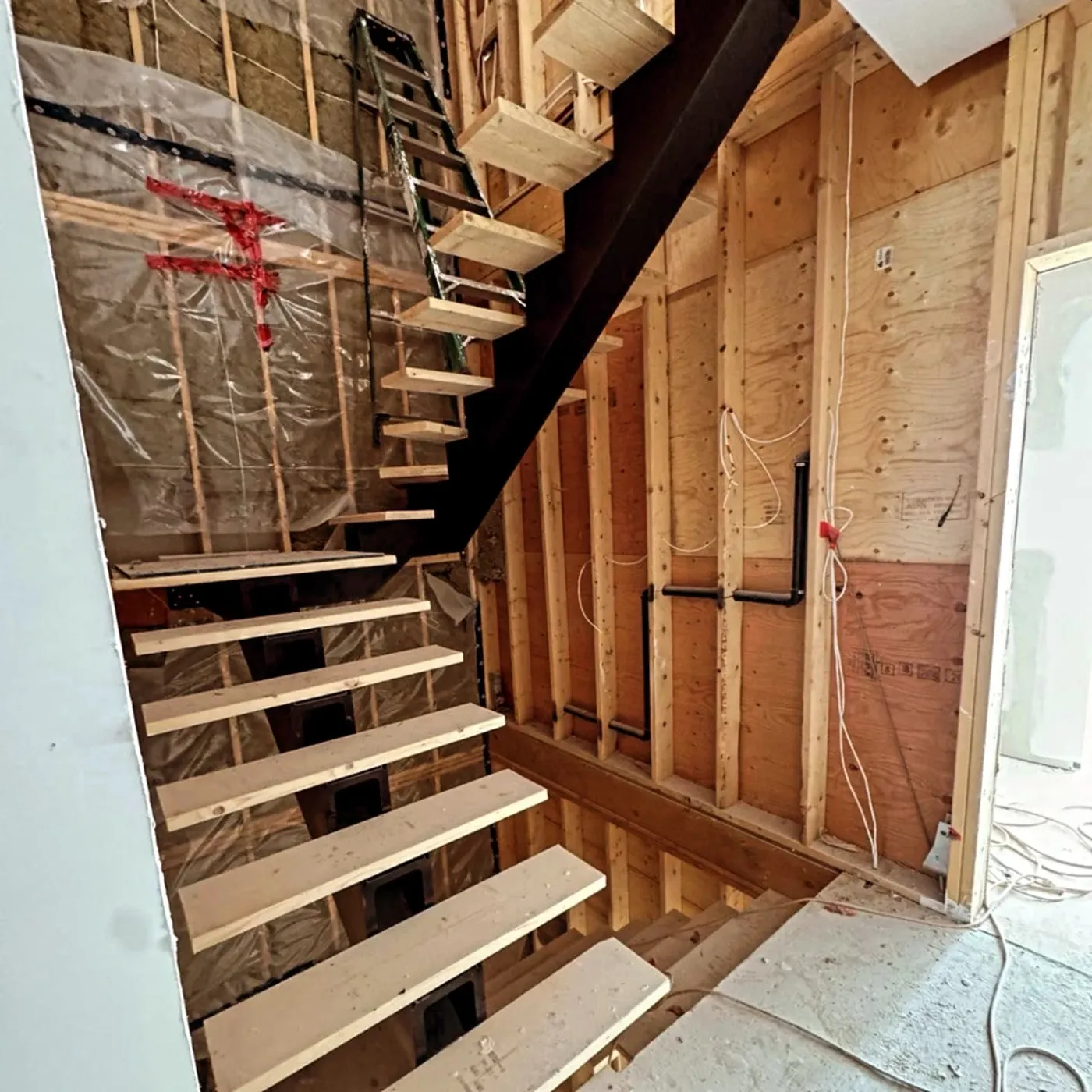
Structural Wall Reinforcement for Floating Stairs in Toronto, ON
Wall and support reinforcement for floating stairs that need upgraded backing or load distribution — engineered and documented before installation begins.
Toronto Floating Stairs provides structural wall reinforcement for cantilevered floating stair installations in Toronto homes, lofts, and commercial spaces where the existing wall assembly isn't adequate to carry stringer bracket loads.
Cantilevered floating stairs transfer significant bending loads into the wall at each bracket location. In a properly framed modern wall with engineered lumber, this is manageable with appropriately sized bracket hardware. In an older Toronto home with 2x4 studs at 24-inch spacing, or a plaster wall over masonry where the condition behind the surface is unknown, the capacity may not be there.
We assess wall capacity during the site visit — opening test patches where necessary to verify framing, condition, and stud spacing. We don't guess. If the wall needs reinforcement, we design the reinforcement before any stair fabrication begins and include it in the OBC permit drawings.
Reinforcement options depend on the existing wall construction. For wood stud walls with inadequate stud depth or spacing, we add a hidden steel plate spanning multiple studs to distribute the bracket load across more framing members. For masonry walls, we design anchor bolts into the masonry with appropriate embedment depth and spacing. For walls where none of these options are practical, we install a hidden steel post inside the wall cavity, transferring stringer loads directly to the floor structure and bypassing the wall entirely.
The goal in every case is to leave the finished wall looking like nothing happened behind the drywall, while ensuring the structural system performs as designed for the life of the staircase.
Common reinforcement scenarios in Toronto
Pre-war Toronto homes in Rosedale, the Annex, and Cabbagetown frequently have lathe-and-plaster walls over 2x4 framing with aged condition and inconsistent stud spacing — all of which require verification and often reinforcement. Converted warehouse and industrial lofts in Liberty Village and the Distillery District often have masonry or concrete perimeter walls that require specialty anchor solutions. Semi-detached homes where the floating stair is planned against a demising wall add party wall considerations that affect the reinforcement design.
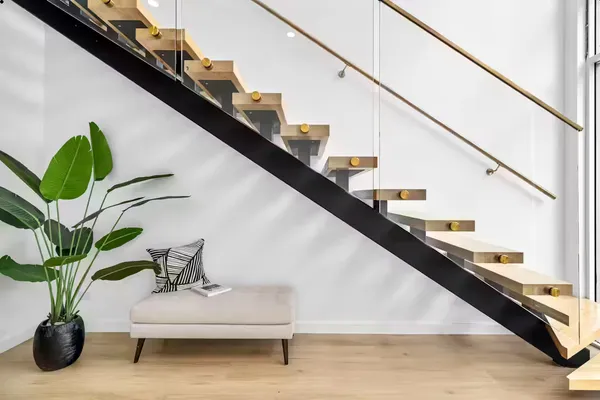
Assess your wall conditions before designing your stair
We open the wall, assess what's there, and specify only the reinforcement required for your specific project.
- ✓ Hidden steel plate spanning studs
- ✓ Masonry anchor bolt systems
- ✓ Hidden steel post to floor
- ✓ Engineered lumber blocking
- ✓ Full OBC permit documentation
Frequently Asked Questions
How do I know if my wall needs reinforcement for a floating stair? +
Will wall reinforcement be visible after the project is done? +
Does wall reinforcement require a building permit in Toronto? +
How much does wall reinforcement add to the cost of a floating stair project? +
My home is 1920s brick construction. Can a floating stair be anchored into it? +
Need wall reinforcement for your Toronto floating stair?
Site assessment. Wall conditions verified before any design commitment.